
Study permits - IRCC
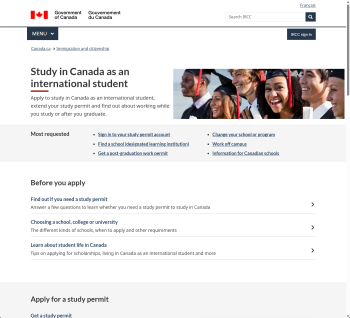
This IRCC page centralizes everything international students need: who needs a study permit, how to apply, required documents, working during studies, changing schools, and post-graduation options like the PGWP. It links to tools for checking eligibility, finding a Designated Learning Institution (DLI), and understanding life in Canada.
Key eligibility and documents
You must be accepted by a DLI, prove you have sufficient funds (tuition, living costs, and return transportation), meet health and character requirements, and follow permit conditions. Most applicants now also need a Provincial or Territorial Attestation Letter (PAL/TAL) from the school before applying. For Quebec, a CAQ is required in addition to the federal study permit.
Updated financial requirement (applies from Sept 1, 2025)
IRCC updates the living-expense threshold annually. For applications filed on or after Sept 1, 2025 (outside Quebec), the minimum living-expense proof is:
- 1 person: $22,895
- 2 people: $28,502
- 3 people: $35,040 (Add amounts for larger families.) These amounts exclude tuition and travel. Quebec follows its own CAQ financial scales.
Work during studies
Eligible students may work off campus up to 24 hours per week during regular academic terms without a separate work permit, and full-time during scheduled breaks, provided all conditions are met. On-campus and co-op rules are explained on the site.
Changing schools (post-secondary)
Since Nov 8, 2024, you cannot simply switch institutions on the same permit. To change your DLI, you must apply to extend your study permit and, in most cases, wait for a decision before moving. Plan timelines carefully.
Biometrics, medicals and police certificates
Most applicants must give biometrics (fingerprints and photo). IRCC keeps biometrics for up to 15 years for temporary resident applications. Depending on program and country, you may also need a medical exam and a police certificate.
After you graduate
The page links to the post-graduation work permit (PGWP) and to pathways that may help you remain in Canada after studies. It also points to resources for French-speaking students and compliance information for DLIs.
Practical tips
- Verify your school’s DLI number before paying deposits.
- Secure your PAL/TAL (or CAQ for Quebec) early; admissions and attestations can take time.
- Budget realistically: the living-expense threshold is a minimum and excludes tuition.
- Keep your study-permit conditions visible and updated; a status lapse can affect work or PGWP eligibility.