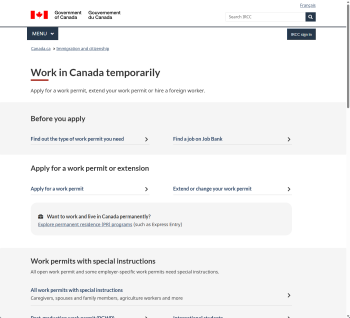

Temporary work permits - IRCC
This IRCC page provides a comprehensive guide for foreign nationals and employers regarding temporary work in Canada. It covers how to apply for a work permit, extend or change one, types of permits, when an employer must obtain a Labour Market Impact Assessment (LMIA), as well as how to hire foreign workers and comply with rules.
Types of work permits and who needs them
Foreign nationals usually need a work permit to work in Canada. Two main categories exist: employer-specific work permits (tied to a particular employer and job) and open work permits (allowing work for any eligible employer in Canada in certain circumstances).
Eligibility depends on factors like nationality, job offer, whether an LMIA is required, and whether the applicant is inside or outside Canada.
How to apply, extend or change a work permit
Applications are generally submitted online. Those inside Canada must meet specific rules—many cannot apply at a port of entry any longer. Applicants must gather relevant documents, pay fees, provide biometrics if required, and ensure their employer-offer details (including NOC code) are correct to avoid delays. Extensions or changes (for example changing employer) also require adherence to instructions and timelines.
Employer obligations and hiring foreign workers
Employers who hire foreign nationals may need to obtain an LMIA from Employment and Social Development Canada (ESDC) unless exempt under certain streams. The employer must offer genuine employment, pay the same wages as Canadians, maintain status for the worker, and abide by compliance requirements. Non-compliant employers may face penalties and be listed in a public “non-compliant employers” listing.
Key eligibility conditions for workers
Applicants must meet admissibility requirements (health, security, criminal record), have valid travel documents, and a job offer if needed. If an LMIA is needed, that must be in place before the application. For open work permits, special rules apply and the applicant is not limited to a single employer.
Practical considerations and compliance
- Double-check whether you need a work permit or if your role is exempt (e.g., some business visitor roles).
- Ensure your job offer includes the correct NOC code and employer details; small mistakes can delay processing.
- If you hold an employer-specific permit and wish to change jobs, you may need to apply for a new permit.
- Employers must stay compliant with wage, working conditions, record-keeping and reporting obligations; workers and employers both risk consequences for non-compliance.
- Workers must monitor the expiry of their permit, status while in Canada, and the impact of travel outside Canada on their permit status.
Why this matters
Understanding the full framework of temporary work in Canada is essential both for foreign nationals and Canadian employers. Misunderstanding permit type, employer obligations, or application eligibility can lead to delays, refusals or being found non-compliant. This official page serves as a go-to resource for navigating the process, reducing risk, and ensuring lawful work in Canada.